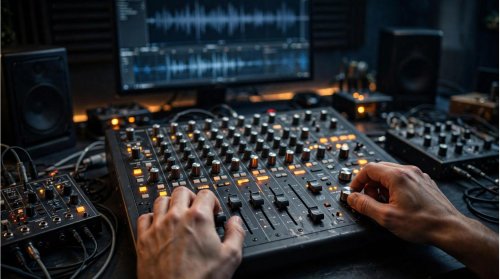
Artist Spotlight: Mike Sain't Louis - Giving Queer Stories a Voice in the Age of AI
From personal lyrics about love, identity and heartbreak to an imaginary queer planet spanning hundreds of songs, Spanish artist Mike Sain't Louis is exploring what it means to be a singer-songwriter in the age of artificial intelligence.


What happens when a songwriter has plenty to say but no band, no recording studio and no budget to bring those ideas to life? For Mike Sain't Louis, the answer was artificial intelligence.
Based in Móstoles, just outside Madrid, Mike describes himself as a cantautor IA – an AI singer-songwriter. He writes his own lyrics and directs every song and music video, while AI tools generate the music and vocals. But behind the technology lies something deeply personal: stories about queer identity, love, mental health, discrimination, heartbreak and the experiences that have shaped his life. Since beginning to release music in 2024, Mike has built an entire creative universe around his work: Planeta Gayfolk, an imaginary queer world told through hundreds of songs, multiple albums and an unmistakable blend of humour, emotion and Spanish camp.
We spoke to Mike about creative freedom, artistic identity, the controversies surrounding AI-generated music and why the human story behind a song still matters most.
The Interview
KiBeat: Who are you, and how did you come up with the idea of bringing AI into your music production?
Mike Sain't Louis: I'm Mike Sain't Louis, from Móstoles, just outside Madrid. I describe myself as a cantautor IA, an AI singer-songwriter. I write the lyrics and direct every song and video, while the music and vocals are created using AI tools, including Suno. I'd been writing lyrics for years. I had songs about love, homophobia, breakups and things I'd experienced myself, but I didn't have a band or the money to record them professionally. AI gave me the opportunity to hear those lyrics as actual songs for the first time.
I've been releasing music since 2024, and that same year one of my songs, Tan Cateto, went viral on TikTok. It was the beginning of a much bigger creative journey.
KiBeat: How does AI influence your musical identity and your personal style?
Mike Sain't Louis: My identity is in the lyrics. They're mostly in Spanish, often humorous, sometimes deeply sad, and they speak openly about gay love, mental health, bullying, homophobia and relationships with narcissists. AI has given me the freedom to explore different musical worlds, from alternative pop and electropop to copla and plenty of Spanish camp.
Eventually, I had so many songs that I decided to give them a planet of their own. That's how Planeta Gayfolk was born: an imaginary queer universe told through three albums – Descubierto un nuevo planeta llamado GAYFOLK, Ojalá se pudiera viajar a GAYFOLK and El día de la liberación. Together, they contain 275 tracks.
In November 2026, I completed my fourth album, El inculto artista de culto, featuring 99 songs, each accompanied by its own music video. The project also explores different languages, with songs in Spanish, English, German, French and Italian.
KiBeat: How do your fans react to the combination of human and artificial creativity?
Mike Sain't Louis: In very different ways. Some people discover my music through the humour and end up connecting with the saddest stories. Others stop listening as soon as they see the word AI.
I understand that people have doubts and that the technology deserves criticism. What I find difficult is when someone dismisses everything without even reading a single lyric. The machine hasn't lived my life. But the experiences I write about are mine.
KiBeat: What advantages and challenges do you see in working with AI compared with traditional music production?
Mike Sain't Louis: The biggest advantage is accessibility. Someone without a band or a studio budget can now turn their ideas into finished songs and release them to the world. I publish everything independently, through my own label, and all my music is available to stream and download for free. The challenge is that AI can generate endless versions of something that sounds technically perfect but has absolutely nothing to say. The real work is choosing.
I listen to countless versions, compare them and discard most of them. Even a pause or the emphasis on a single word can completely change the meaning of a lyric. If I've written something with a bit of venom and the AI turns it into a romantic performance, that version simply doesn't work – no matter how beautiful it sounds.
KiBeat: Can you share an example of AI introducing a surprising or unexpected musical idea into one of your songs?
Mike Sain't Louis: I'd rather be honest than invent a nice story for the interview. The surprises I notice most often are actually the ones that go wrong: a version can sound beautiful but be completely disconnected from the emotion of the lyrics. Those are the moments when I have to say no. And when something genuinely unexpected does work, I only keep it if it still communicates what I originally wanted to say.
KiBeat: How do you think AI will change the music industry over the next ten years?
Mike Sain't Louis: I don't have a magic answer. There will undoubtedly be a lot of discussion about transparency, copyright, ownership and protecting the people who make their living from music. And there should be. But I also think we need to talk about what the artist behind each project actually has to say.
My hope is that being transparent about how a song was created will eventually become completely normal. Listeners deserve to know what they're hearing and who is behind it.
KiBeat: Do you see ethical questions or concerns surrounding the use of AI in music?
Mike Sain't Louis: Absolutely. I understand the concerns about copyright, musicians' livelihoods and the way these systems are trained. These are important debates, and they need to happen. My responsibility is to be completely transparent about my own work. I won't pretend that synthetic vocals come from my own throat. I clearly explain on my websites and whenever I talk about my music that the lyrics and artistic direction are mine, while the music and vocals are AI-generated.
At the same time, I don't believe we should erase the creative work of someone who writes his own stories and builds an entire artistic project around them simply because he uses AI as a tool.
KiBeat: What advice would you give other artists who want to incorporate AI into their creative process?
Mike Sain't Louis: Start with what you want to say. Before generating anything, know who's speaking in the song, who they're talking to and what they want to communicate. Don't release something just because the technology has produced it. Keep listening until you recognise the character and emotion you originally imagined. And be honest about the tools you use. People are free to disagree with your approach, but at least they'll know exactly what they're listening to.
About Mike Sain't Louis
Mike Sain't Louis is a Spanish musician, lyricist and visual artist from Móstoles, Madrid. Describing himself as a cantautor IA (AI singer-songwriter), he writes all his lyrics and directs his songs and videos, combining personal storytelling with AI-generated music and vocals. He is the creator of Planeta Gayfolk, a queer musical universe featuring a three-album trilogy of 275 tracks, as well as El inculto artista de culto, a 99-song project with 99 accompanying music videos.
All of his music is available to stream and download for free.
Discover Mike Sain't Louis
Official Website
Planeta Gayfolk
YouTube
Spotify
Press photography: Mike Sain't Louis – Press Photos · Photo credit: Mike Sain't Louis / Planeta Gayfolk
Teilen
Was ist Ihre Reaktion?
 Gefällt mir
0
 Gefällt mir nicht
0
 Liebe
0
 Lustig
0
 Wütend
0
 Traurig
0
 Wow
0